Quick answer
Keep events in a shared calendar, jobs as tasks with one owner, purchases on one grocery list, and open questions as decisions. Every task has one owner who handles it from start to finish, and a 15-minute weekly check-in reviews the week, open tasks, the balance, one decision, and groceries.
Most couples don't need a more detailed system. They need a smaller one that both people actually use. This one has three parts: four places where every kind of household information lives, one rule about ownership, and a 15-minute check-in each week. You can run it with any tools; below, we show how it works in FamHead.
Part 1: Give every kind of information one home
Household stress often comes from information living in five places at once: texts, a fridge note, someone's head, an email, and a group chat. Decide where each kind goes, and keep it there.
| Kind of information | Its home | Example |
|---|---|---|
| Something happening at a time | Your shared calendar | Dentist, Tuesday at 3 |
| A job someone has to do | A task with one owner | Call to book the dentist |
| Something to buy | The shared grocery list | Toothpaste, 2 tubes |
| A choice you haven't made yet | A decision | Which week do we take off in August? |
| Where something is stored | A home inventory | Spare charger, hall closet |
| Money, documents, passwords | A dedicated tool | Banking app, password manager |
In FamHead, tasks, the grocery list, decisions, and the inventory all live in one shared household. FamHead has no calendar, so keep events in a shared Apple or Google calendar.
Part 2: The ownership rule
Every task has exactly one owner, and the owner handles all of it: noticing it, doing it, and following up. "I'll help with the school stuff" isn't ownership. "I own school forms this term" is.
- No task belongs to "us". If two people work on it, one still owns it.
- Hand over whole jobs, not single steps. Owning the laundry means noticing the basket, not waiting to be told.
- The owner updates the task, so nobody has to ask whether it's done.
- Unclaimed work is visible, not silently absorbed. FamHead shows tasks with no owner separately.
Part 3: The 15-minute weekly check-in
Pick a regular time, such as Sunday evening, and go through the same five points. Short and regular beats long and occasional.
- The week ahead (3 minutes): look at the calendar together. Travel, late nights, deadlines, birthdays.
- Open tasks (4 minutes): what's overdue, what's stuck, and what no longer matters. Give every unowned task an owner.
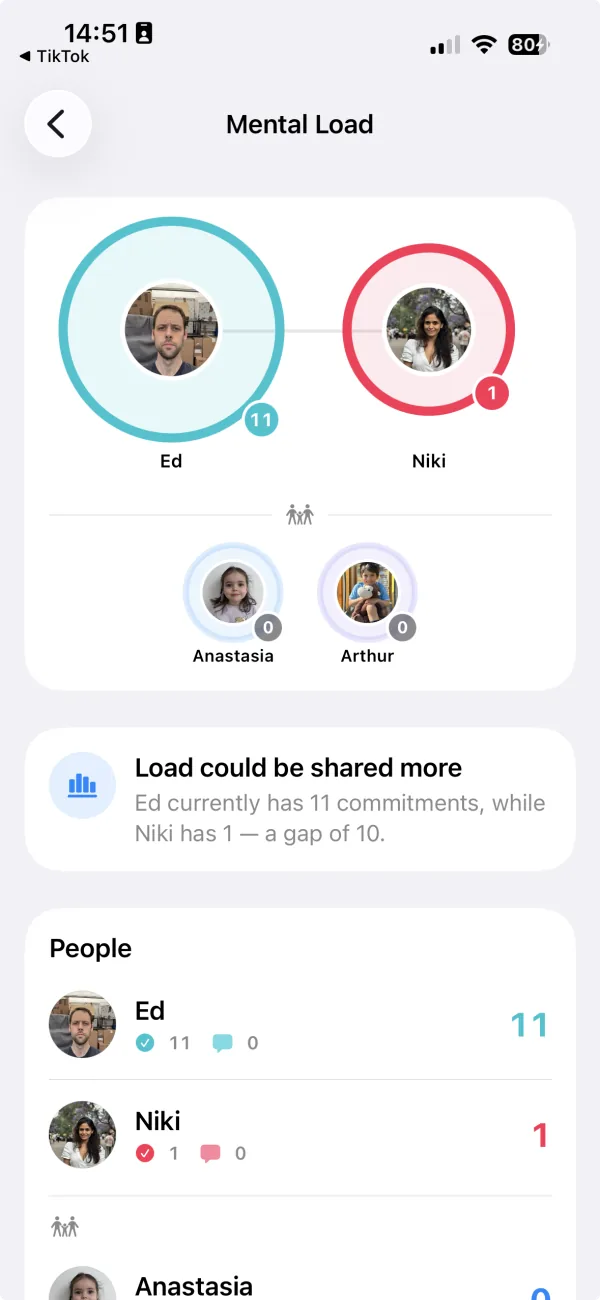
- The balance (3 minutes): open FamHead's Mental Load view, or take the free mental load test together the first time. If one of you holds far more open tasks and decisions, move a whole job across.
- Decisions (3 minutes): settle one open question, record the outcome, and add the tasks that follow.
- Groceries (2 minutes): pick a few dinners and add what's missing to the shared list.
Once a month, spend an extra ten minutes on the system itself: is anything living in two places? Is one person still doing all the noticing? Which recurring chores should repeat automatically?
Setting it up in FamHead
- Create a household and invite your partner with a QR code or link.
- Add children without a phone if they have jobs too.
- Add this week's tasks and give each one an owner. Set repeats for chores that recur.
- Add your grocery staples once; after that they come back from history.
- Put open questions into decisions with the people involved.
- Add the Quick Add widget so capturing something takes one tap.
The setup guide walks through each step, and our chore list for couples gives you a starting split.
Frequently asked questions
What is the best way to manage a household as a couple?
Give every kind of information one home, give every task one owner who handles it from start to finish, and review the split in a short weekly check-in. The tools matter less than both people using the same ones.
What is the best household management app for couples?
For sharing tasks, groceries, and decisions with clear ownership on iPhone and iPad, FamHead, which also shows each partner's open commitments side by side. For combining two calendars and planning dates, Cupla. See FamHead vs Cupla.
How do we split household work fairly?
List everything, including the planning work, then split whole jobs according to each person's time, not a strict 50/50 count. Our guide on dividing household chores fairly covers the conversation.
Does this work for roommates?
Yes. The four places and the ownership rule work for any shared home. Use the check-in to agree on shared supplies and cleaning, and keep personal things out of the shared space.